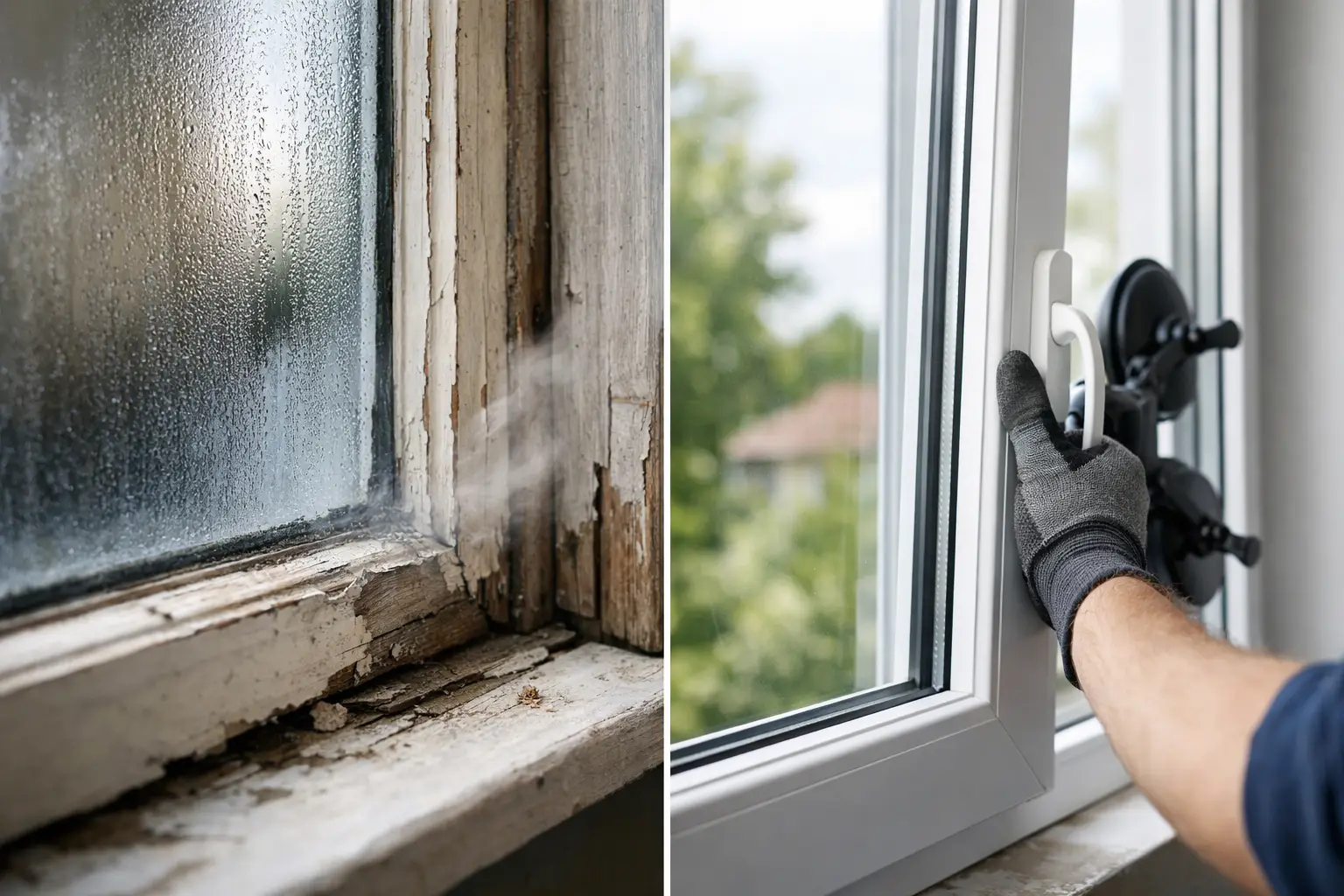
Condensation on the inside of the glass, a cold draught near the window in winter or traffic noise coming into the room are not just discomforts that come with an old house. They can be a sign that the window no longer does its main job. The question of when to replace old windows becomes especially important before a major renovation, facade works or the start of the heating season – a timely decision helps you avoid excess energy costs and possible moisture damage.
Whether windows need replacing should not be judged only by how worn the frame looks. A window is an important part of the building envelope that affects room temperature, air quality, sound insulation and the look of the house. Sometimes adjusting the window or replacing the seals is enough; in other cases it makes sense to choose a new, energy-efficient window system that suits the building. If the problem is limited to maintenance or a minor repair, consider Koduaken’s window maintenance and repair service before replacing anything.
When to replace old windows: signs you should not ignore
One of the clearest signs is a draught. If you feel cold air near a closed window, the curtains move, or the heating constantly has to work harder under the window, the cause may be worn seals, sagging frames or a leaky joint between the wall and the frame. Adjusting the window may help, but with older structures it may no longer solve the problem for good.
If the problem seems to be related to the hardware, seals or window settings, a more thorough service may be worth doing before replacement.
Windows “sweat” or there is moisture between the panes
Condensation on the inner pane does not always mean the window is faulty. Often the cause is too humid indoor air, insufficient ventilation, or warm air not reaching the inner surface of the window. But if condensation keeps forming at the edges of the window or on the frames, and persists even with normal airing, it is worth checking the window’s thermal performance and the room’s ventilation.
Fog, water droplets or a dark deposit between the panes of the glass unit, on the other hand, are a clear sign that the unit has lost its seal. In that case it no longer provides the designed thermal or sound insulation. Sometimes only the glass unit can be replaced, but with badly worn frames or an outdated design, replacing the whole window may make more economic sense.
When choosing a new window, pay attention to the build of the glass unit and, for example, a warm-edge spacer, which reduces the thermal bridge and the risk of condensation.
Frames are rotten, cracked or hard to use
Paint damage, soft spots, cracks and peeling finish on wooden frames often point to long-term exposure to moisture. On PVC windows, seals, hardware and handles wear over time, and the frame can deform due to incorrect installation or heavy load. Aluminium frames are very durable, but their seals, fixings and opening mechanisms also need regular checks.
If the window will not close without force, the handle is stiff or the sash rubs against the frame, the problem is not just convenience. A window that does not close properly lets more air through and puts even more strain on the hardware. The first step is to have a specialist inspect the window and adjust it if needed. If the adjustment options are exhausted or the damage is extensive, it is time to plan a replacement.
Koduaken offers window maintenance, repair and adjustment as well as glass unit replacement, so not every problem means you have to order a new window straight away.
Heating bills are rising and it is cold under the window
A building’s energy use does not depend only on its windows – wall, roof and floor insulation, ventilation and the residents’ habits matter too. Even so, old windows with single or double glazing and weak seals can be a significant source of heat loss. This is especially noticeable with large glazed areas, north-facing rooms and windy locations.
The benefit of new windows is not only a lower heating demand. Thanks to a warmer inner surface, it is more comfortable to sit near the window, the room temperature is more even and the radiators do not have to work harder to make up for the discomfort.
When choosing a new window, ask for the thermal transmittance of the whole window rather than judging only the glass unit. The frame, glass, spacer and installation work as one whole.
Street noise is disturbing even with the window closed
If traffic, trains, a playground or other outside noise can be clearly heard indoors even when the window is closed, the cause may be the window’s construction, the glass unit or air leaks. Sound insulation does not automatically improve just by using thicker glass. The result depends on the combination of glass thicknesses and gaps, the build of the glass unit, the tightness of the frame and professional installation.
In a noisy location it is worth designing the window specifically for sound insulation. This is a good example of a situation where the cheapest standard solution may not deliver the result you want. A well-chosen glass unit can make a bedroom, home office or classroom noticeably quieter.
The windows no longer fit the renovation plan
It often makes sense to replace windows together with facade insulation, exterior finishing or a major interior renovation. That way the window position, joints and water drainage can be solved as a whole. If new facade insulation is installed around the old windows, replacing them later may mean extra work and redoing the finishes.
In apartment buildings you also need to consider the building’s uniform architecture. Window divisions, colour, ventilation and opening type often have to follow the decisions of the housing association or the project documentation.
In a private house, replacing the windows gives you a chance to change more: enlarge the glazed area, add a bigger terrace door or choose, for example, an aluminium sliding door for a room with a wide view. You can compare the options in our product range.
Does an old window need repair or replacement?
Maintenance makes sense if the frames and glass units are in good condition and the problem is limited to worn seals, unlubricated hardware or a small adjustment error. Regular cleaning, hardware checks and seal care also extend the life of new windows.
Replacement is justified when several problems occur at once: the glass unit is damp, the frames are damaged, the window does not close properly and the room is cold or noisy. Repairing individual parts may also not be worthwhile if the window’s technical level falls well short of today’s expectations for energy efficiency and comfort.
The decision should not be based on the age of the frame alone. A well-maintained window can last a long time, while a solution installed 15–20 years ago may already need updating because of energy costs, comfort or the condition of the glass unit. An on-site measurement and assessment gives a more reliable basis for the decision than a photo or a rough size.
What time of year should you replace windows?
Windows can be replaced all year round if the work is planned properly and the installation methods suit the weather. Spring and summer are popular because more renovation is done then and open window openings cause less discomfort. However, production and installation lead times can be longer in this period.
Do not leave window replacement until the last minute before autumn. If problems only show up with the first frosts, there may be fewer options left for choosing a suitable solution and planning the installation. Winter installation is also entirely possible, and in houses under construction that are still an “open shell”, windows can be installed very successfully in winter. At that stage a temporary chill is usually not a problem, and installing the windows helps make the building weatherproof sooner.
Windows are also regularly replaced in winter in occupied apartments and houses. With good organisation the opening is left open for as short a time as possible and the work is done room by room to keep the disruption minimal. One day with a slightly cooler room is often better than a whole winter with poorly insulating windows and the higher heating bill that comes with them.
At today’s energy prices, replacing old, poorly insulating windows before or during winter can noticeably reduce heating costs. The less heat escapes through the windows, the less you have to keep heating the rooms. So there is no need to postpone window replacement until spring if your current windows let the cold in or cause large heat losses.
Our installers are experienced professionals, and we do everything we can to make winter installation as comfortable, quick and smooth as possible. The opening is kept open for the minimum time, the joints are made to the required standard, and the work is planned according to the weather and the specifics of the building.
For an apartment or a private house, it is worth starting the ordering process well before the desired installation date. That leaves enough time to think through the material, colour, opening type, glass unit and any ventilation solutions. For a larger house, a housing association or commercial premises, you also need to allow for design, approvals and phased installation.
Choosing a new window starts with the building, not the catalogue
PVC windows are a practical choice for many homes: they are energy-efficient, easy to maintain and offer good value for money. Modern PVC systems suit both renovated buildings and new builds and come in a range of colours and finishes.
Aluminium is a strong and dimensionally stable material that works well for large windows, glass facades, front doors and sliding and folding doors. Its advantage is most visible when the architecture calls for slimmer visible profiles, large glazed areas or heavy use. An aluminium solution may be a bigger investment, but in the right place it offers durability and design freedom that a standard solution cannot always provide.
In a new house, all openings do not have to be made of the same material. For example, it can be practical to combine PVC windows with an aluminium front door.
When choosing, also think about how each room is used. In a bedroom, sound insulation may come first; in the kitchen and bathroom, ventilation; by the terrace, an easy passage; and in a public building, heavy use or other technical requirements. So the right solution is not necessarily the same for every room.
Installation quality determines the real result
Even a very good window will not deliver the expected result if the measurement or installation is inaccurate. The joint between the window and the wall must be airtight and weatherproof, while making sure that moisture does not get trapped in the structure.
Poorly made joints or unfinished reveals can cause draughts, cold bridges and moisture problems that are wrongly blamed on the new window. That is why, in addition to the window’s technical specifications, it is worth considering who will measure and install it, and how.
A full service reduces the risks because measuring, production, installation and finishing are all coordinated. A Koduaken specialist can assess the current situation, explain the differences between PVC and aluminium solutions and prepare a quote that takes into account the building, your needs and your budget.
If you can already feel cold, see moisture or hear more noise than usual near your windows, there is no need to wait for the next major renovation. It makes sense to have the situation assessed and decide based on the actual condition and needs. That way a new window will improve your home’s comfort, warmth and reliability all year round.
Do your windows need replacing?
If you are not sure whether your current windows can still be adjusted or repaired, or whether it would be wiser to replace them, have a specialist assess their condition. Koduaken will help you choose a suitable PVC or aluminium solution, take the measurements and plan the installation as a whole.
Request a quote from Koduaken and find the right windows for your home